You are currently browsing Paula Lindstam’s articles.
I usually, not always, use Certo Liquid Fruit Pectin for my jam. The recipe booklet that I use is from 1975 when the liquid pectin came in bottles. Now the pectin comes in sealed envelopes and each envelope is equivalent to one half-bottle. As you can see, my recipe booklet is falling apart. The new recipe sheet that comes inside the packages now isn’t as comprehensive as the old one. I do not water-bath can my jam. There is enough sugar in it to act as a preservative. Using canning lids keeps air from getting in. When I was a child, my mother only used paraffin to cover the jam and many people still do it that way.
- This is how I prep for a jam-making session
- Set out enough sanitized jars and rings to match the yield of the recipe, either pints, cups, or half-cups.
- Put the appropriate number of lids into a small saucepan of water over low heat.
- Set out my canning funnel, a ladle, metal serving spoon, and small dish.
- Cut open the envelope of Certo and set it in the small dish.
- [The small dish is for the foam (which is just as delicious as the jam, only foamy)]
- Blueberry Jam
- Yield 9-1/2 cups (6 lb.)
- 4-1/2 cups prepared fruit (about 1-1/2 quarts fully ripe blueberries)
- 2 Tbsp. lemon juice
- 7 cups (3 lb.) sugar
- 2 envelopes Certo Liquid Fruit Pectin
Thoroughly crush, one layer at a time, about 1-1/2 quarts blueberries. Measure 4-1/2 cups into a very LARGE saucepan. Stir in lemon juice. Stir in sugar and mix well.
Over high heat, bring to a full rolling boil and boil hard 1 minute, stirring constantly. Remove from heat; at once stir in Certo. Skim the foam off with a metal spoon. Continue to stir and skim. Ladle into jars, leaving 1/2″ room at the top.
Wipe the rims of the jars and screw on the lids. Turn the jars upside down for at least thirty minutes (or as long as hours and hours–doesn’t matter). If the fruit is floating, give the jars a shake every once in awhile. Turn the jars right side up and let cool completely before marking and storing.
Many times it can take more than a day for the jam to set. Try not to worry. If it really does not set, then you have a nice batch of syrup or you can try to process it again. I have never done that, I just go the syrup route. C’est la vie.
I usually, not always, use Certo Liquid Fruit Pectin for my jam. The recipe booklet that I use is from 1975 when the liquid pectin came in bottles. Now the pectin comes in sealed envelopes and each envelope is equivalent to one half-bottle. As you can see, my recipe booklet is falling apart. The new recipe sheet that comes inside the packages now isn’t as comprehensive as the old one. I do not water-bath can my jam. There is enough sugar in it to act as a preservative. Using canning lids keeps air from getting in. When I was a child, my mother only used paraffin to cover the jam and many people still do it that way.
- This is how I prep for a jam-making session
- Set out enough sanitized jars and rings to match the yield of the recipe, either pints, cups, or half-cups.
- Put the appropriate number of lids into a small saucepan of water over low heat.
- Set out my canning funnel, a ladle, metal serving spoon, and small dish.
- Cut open the envelope of Certo and set it in the small dish.
- [The small dish is for the foam (which is just as delicious as the jam, only foamy)]
- Strawberry or Blackberry or Dewberry or Boysenberry or Youngberry Jam
- Yield 8 cups (5 lb.)
- 4 cups prepared fruit (about 2 qt. fully ripe berries)*
- 7 cups (3 lb.) sugar
- 1 envelope Certo Liquid Fruit Pectin
First, prepare fruit. Crush completely, one layer at a time, about 2 quarts fully ripe berries. (If desired, sieve half of pulp to remove some of the seeds.) Measure 4 cups into a very LARGE saucepan. *(With strawberries, or other berries lacking tartness, use 3-3/4 cups fruit and add 1/4 cup lemon juice.) Stir in sugar and mix well.
Over high heat, bring to a full rolling boil and boil hard 1 minute, stirring constantly. Remove from heat; at once stir in Certo. Skim the foam off with a metal spoon. Continue to stir and skim. Ladle into jars, leaving 1/2″ room at the top.
Wipe the rims of the jars and screw on the lids. Turn the jars upside down for at least thirty minutes (or as long as hours and hours–doesn’t matter). If the fruit is floating, give the jars a shake every once in awhile. Turn the jars right side up and let cool completely before marking and storing.
Many times it can take more than a day for the jam to set. Try not to worry. If it really does not set, then you have a nice batch of syrup or you can try to process it again. I have never done that, I just go the syrup route. C’est la vie.
Please check the updates below for making currant jelly without added pectin.
I usually, not always, use Certo Liquid Fruit Pectin for my jelly. The recipe booklet that I use is from 1975 when the liquid pectin came in bottles. Now the pectin comes in sealed envelopes and each envelope is equivalent to one half-bottle. As you can see, my recipe booklet is falling apart. The new recipe sheet that comes inside the packages now isn’t as comprehensive as the old one. I do not water-bath can my jelly. There is enough sugar in it to act as a preservative. Using canning lids keeps air from getting in. When I was a child, my mother only used paraffin to cover the jelly and many people still do it that way.
- This is how I prep for a jelly-making session
- Set out enough sanitized jars and rings to match the yield of the recipe, either pints, cups, or half-cups.
- Put the appropriate number of lids into a small saucepan of water over low heat.
- Set out canning funnel, ladle, metal serving spoon, and small dish.
- Cut open the envelope of Certo and set it in the small dish.
- [The small dish is for the foam (which is just as delicious as the jam, only foamy)]
- Currant Jelly: Yield 7-1/4 cups (5-1/2 lb.)
- 5 cups prepared juice (about 4 lb. fully ripe red currants)
- 7 cups (3 lb.) sugar
- 1 envelope Certo Liquid Fruit Pectin
First, prepare juice. Crush about 4 lb. (3 quarts) fully ripe red currants. Add 1 cup water; bring to a boil and simmer, covered, 10 minutes. Place in jelly bag; squeeze out juice. Measure 5 cups into a very LARGE saucepan. Add sugar and mix well.
Place over high heat and bring to a boil, stirring constantly. At once stir in Certo. Then bring to a full rolling boil and boil hard 1 minute, stirring constantly. Remove from heat, skim off foam with a metal spoon, and pour quickly into jars.
Wipe the rims of the jars and screw on the lids. Turn the jars upside down for at least thirty minutes (or as long as hours and hours–doesn’t matter). Turn the jars right side up and let cool completely before marking and storing.
Many times it can take more than a day for jelly to set. Try not to worry. If it really does not set, then you have a nice batch of syrup or you can try to process it again. I have never done that, I just go the syrup route. C’est la vie.
Update 8/21/2021 . . . I picked 3 cups currants and smashed them with a potato smasher. Put them over heat with a splash of water and brought to a boil. Let them boil for a couple minutes. Smashed the remaining whole berries with a wooden spoon. Turned off the heat and poured into a sieve over a smallish bowl. Stirred and scraped, trying to get as much juice as possible out of the berries without the seeds. The final yield was 1-1/3 cups currant juice. Juice poured back into the pan. Stirred in 2 cups sugar. Boiled until it reached the gel stage. I eyeballed this, the gel stage. Yield 1/2 pint and 2 1/4 pint jars. It’s gelled so, no problem. Did not use pectin additive. Delicious!
Another update 8/13/2025 . . . I picked 7.4 ounces of currants. Yes, less and less every year. Sigh. Anyway, I added 1/8 cup water and boiled and smashed the berries. Used my smallest jelly bag and let it strain for many hours. I ended up with 1/2 cup juice. In my very smallest sauce pan I placed the juice and 1/2 cup sugar. Boiled and simmered for not long, maybe fifteen minutes? Ran a gel test by putting a teaspoon of jelly on a cold saucer and ran my finger through it. It stayed put. Gelled! Yield was about 2/3 cup jelly. Not much, but I do love currant jelly on toast.
I could eat this peach jam out of the jar with a spoon, and have done so! I haven’t tried the pear jam, but it’s the same recipe so I included it in case you want to try it. One time the local grocery store was selling cases of bruised cooking peaches for a very low price. I thought I had died and gone to heaven. We had peachy desserts for quite a few days, along with this delicious peach jam.
- Peach or Pear Jam
- Yield: 9 cups (5-1/2 lb.)
- 4 cups prepared fruit (about 3 lb. fully ripe peaches or pears)
- 1/4 cup lemon juice
- 7-1/2 cups (3-1/4 lb.) sugar
- 1 envelope Certo Liquid Fruit Pectin
First, prepare fruit. Peel and pit fully ripe peaches; core fully ripe pears. Grind or chop very fine. Measure 4 cups into a very LARGE saucepan. Add lemon juice. Stir in sugar and mix well.
Place over high heat, bring to a full rolling boil and boil hard 1 minute, stirring constantly. Remove from heat; at once stir in Certo. Skim off foam with a metal spoon. Ladle into jars, leaving 1/2″ headspace.
Wipe the rims of the jars and screw on the lids. Turn the jars upside down for at least thirty minutes (or as long as hours and hours–doesn’t matter). If the fruit is floating, give the jars a shake every once in awhile. Turn the jars right side up and let cool completely before marking and storing.
Notes: I usually, not always, use Certo Liquid Fruit Pectin for my jam. The recipe booklet that I use is from 1975 when the liquid pectin came in bottles. Now the pectin comes in sealed envelopes and each envelope is equivalent to one half-bottle. As you can see, my recipe booklet is falling apart. The new recipe sheet that comes inside the packages now isn’t as comprehensive as the old one. I do not water-bath can my jam. There is enough sugar in it to act as a preservative. Using canning lids keeps air from getting in. When I was a child, my mother only used paraffin to cover the jam and many people still do it that way.
- This is how I prep for a jam-making session
- Set out enough sanitized jars and rings to match the yield of the recipe, either pints, cups, or half-cups.
- Put the appropriate number of lids into a small saucepan of water over low heat.
- Set out my canning funnel, a ladle, metal serving spoon, and small dish.
- Cut open the envelope of Certo and set it in the small dish.
- [The small dish is for the foam (which is just as delicious as the jam, only foamy)]
What do you do with this? Well, it goes good with lamb and also makes a beautiful presentation in Thumbprint Cookies at Christmastime, along with Raspberry Jam or Currant Jelly.
- Fresh Mint Jelly
- Yield: 3-1/4 cups (2-1/2 lb.)
- 1-3/4 cups mint infusion (1-1/2 cups fresh mint)
- 2 Tbsp. lemon juice
- Green food coloring (optional)
- 3-1/2 cups (1-1/2 lb.) sugar
- 1 envelope Certo Liquid Fruit Pectin
First, prepare mint infusion. Wash 1-1/2 cups firmly packed mint leaves and stems. Place in a large saucepan and crush with a masher or glass. Add 2-1/4 cups water and bring to a boil. Remove from heat, cover, and let stand 10 minutes. Strain. Measure 1-3/4 cups into saucepan. Add lemon juice and a few drops of green food coloring if you decided to use it. Stir in sugar and mix well.
Place over high heat and bring to a boil, stirring constantly. At once stir in Certo. Then bring to a full rolling boil and boil hard 1 minute, stirring constantly. Remove from heat, skim off foam with a metal spoon, and pour quickly into jars.
Wipe the rims of the jars and screw on the lids. Turn the jars upside down for at least thirty minutes (or as long as hours and hours–doesn’t matter). Turn the jars right side up and let cool completely before marking and storing.
Many times it can take more than a day for the jelly to set. Try not to worry. If it really does not set, then you have a nice batch of syrup or you can try to process it again. I have never done that, I just go the syrup route. C’est la vie.
I usually, not always, use Certo Liquid Fruit Pectin for my jelly. The recipe booklet that I use is from 1975 when the liquid pectin came in bottles. Now the pectin comes in sealed envelopes and each envelope is equivalent to one half-bottle. My recipe booklet is falling apart. The new recipe sheet that comes inside the packages now isn’t as comprehensive as the old one. I do not water-bath can my jelly. There is enough sugar in it to act as a preservative. Using canning lids keeps air from getting in. When I was a child, my mother only used paraffin to cover the jelly and many people still do it that way.
- This is how I prep for a jelly-making session
- Set out enough sanitized jars and rings to match the yield of the recipe, either pints, cups, or half-cups.
- Put the appropriate number of lids into a small saucepan of water over low heat.
- Set out my canning funnel, a ladle, metal serving spoon, and small dish.
- Cut open the envelope of Certo and set it in the small dish.
- [The small dish is for the foam (which is just as delicious as the jelly, only foamy)]
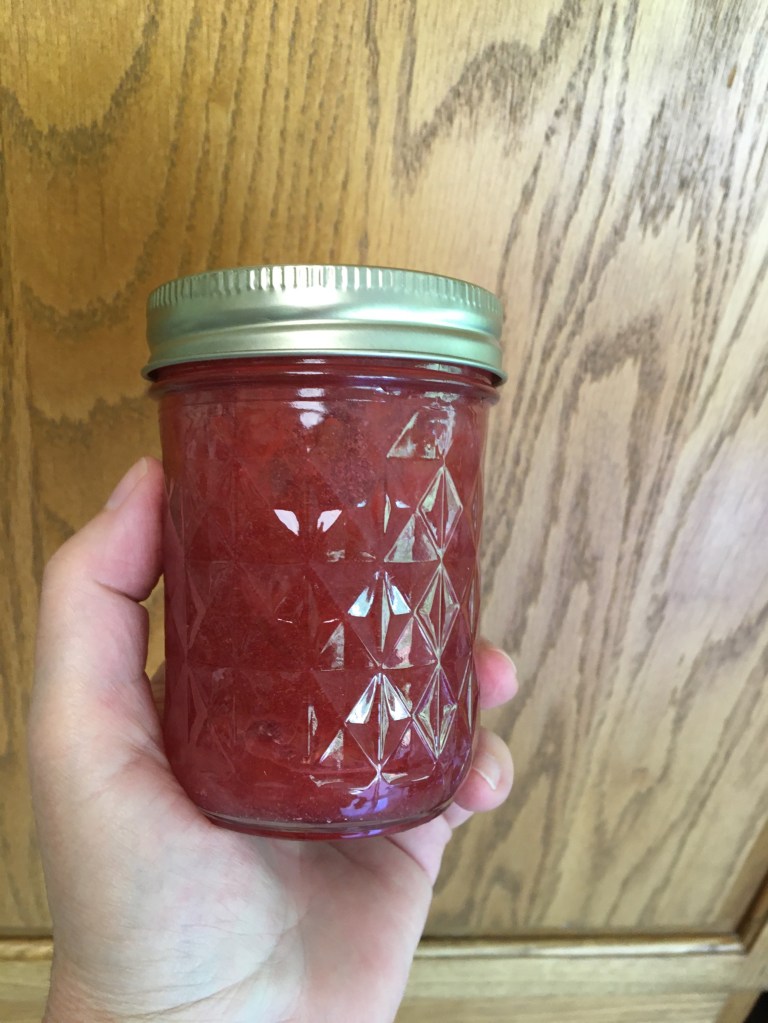
I usually, not always, use Certo Liquid Fruit Pectin for my jam. The recipe booklet that I use is from 1975 when the liquid pectin came in bottles. Now the pectin comes in sealed envelopes and each envelope is equivalent to one half-bottle. As you can see, my recipe booklet is falling apart. The new recipe sheet that comes inside the packages now isn’t as comprehensive as the old one. I do not water-bath can my jam. There is enough sugar in it to act as a preservative. Using canning lids keeps air from getting in. When I was a child, my mother only used paraffin to cover the jam and many people still do it that way.
- This is how I prep for a jam-making session
- Set out enough sanitized jars and rings to match the yield of the recipe, either pints, cups, or half-cups.
- Put the appropriate number of lids into a small saucepan of water over low heat.
- Set out my canning funnel, a ladle, metal serving spoon, and small dish.
- Cut open the envelope of Certo and set it in the small dish.
- [The small dish is for the foam (which is just as delicious as the jam, only foamy)]

- Rhubarb Jam
- Yield: 6-1/4 cups (4 lb.) jam
- 3 cups prepared fruit (about 2 lb. rhubarb)
- 5-1/2 cups (2 lb. 6 oz.) sugar
- 1 envelope Certo Liquid Fruit Pectin
First, prepare fruit. Slice thin or chop about 2 pounds rhubarb. Put the rhubarb into a medium saucepan, add 3/4 cup water, and bring to a boil over medium heat. Reduce heat to simmer, covered, until the rhubarb is soft — about 1 minute. Measure 3 cups into a LARGE pan. Add sugar to pan and mix well.
Over high heat, bring to a full rolling boil and boil hard 1 minute, stirring constantly. Remove from heat; at once stir in Certo. Skim the foam off with a metal spoon. Continue to stir and skim. Ladle into jars, leaving 1/2″ room at the top.

Wipe the rims of the jars and screw on the lids. Turn the jars upside down for at least thirty minutes (or as long as hours and hours–doesn’t matter). If the fruit is floating, give the jars a shake every once in awhile. Turn the jars right side up and let cool completely before marking and storing.

Many times it can take more than a day for the jam to set. Try not to worry. If it really does not set, then you have a nice batch of syrup or you can try to process it again. I have never done that, I just go the syrup route. C’est la vie.

I usually, not always, use Certo Liquid Fruit Pectin for my jam. The recipe booklet that I use is from 1975 when the liquid pectin came in bottles. Now the pectin comes in sealed envelopes and each envelope is equivalent to one half-bottle. My recipe booklet is falling apart. The new recipe sheet that comes inside the packages now isn’t as comprehensive as the old one. I do not water-bath can my jam. There is enough sugar in it to act as a preservative. Using canning lids keeps air from getting in. When I was a child, my mother only used paraffin to cover the jam and many people still do it that way. I have heard that you should not increase the recipe and/or cut the amount of sugar, something about cooking time and setting and preserving. So, stick to the recipe.
- This is how I prep for a jam-making session
- Set out enough sanitized jars and rings to match the yield of the recipe, either pints, cups, or half-cups.
- Put the appropriate number of lids into a small saucepan of water over low heat.
- Set out my canning funnel, a ladle, metal serving spoon, and small dish.
- Cut open the envelope of Certo and set it in the small dish.
- [The small dish is for the foam (which is just as delicious as the jam, only foamy)]
- Rhubarb-Strawberry Jam
- Yield: 6-1/4 cups (4 lb.) jam
- 3-1/2 cups prepared fruit (about 1 lb. rhubarb and 1 quart strawberries)
- 6-1/2 cups (2 lb. 6 oz.) sugar
- 1 envelope Certo Liquid Fruit Pectin
Slice one pound rhubarb and put into saucepan. Add 1/4 cup water and bring to a boil. Reduce heat and let simmer until rhubarb is soft, about 1 minute. Thoroughly crush about 1 quart fully ripe strawberries. Mix the fruits together and measure out 3-1/2 cups. Place the fruit in a LARGE pan. Add sugar to pan and mix well.
Over high heat, bring to a full rolling boil and boil hard 1 minute, stirring constantly. Remove from heat; at once stir in Certo. Skim the foam off with a metal spoon. Continue to stir and skim. Ladle into jars, leaving 1/2″ room at the top.
Wipe the rims of the jars and screw on the lids. Turn the jars upside down for at least thirty minutes (or as long as hours and hours–doesn’t matter). If the fruit is floating, give the jars a shake every once in awhile. Turn the jars right side up and let cool completely before marking and storing.
Many times it can take more than a day for the jam to set. Try not to worry. If it really does not set, then you have a nice batch of syrup or you can try to process it again. I have never done that, I just go the syrup route. C’est la vie.


This recipe originates with Jamie Oliver. It is gluten-free. I have made it many times and it’s incredibly delicious. My blog has turned into a place for me to remember how I did something in case the recipe goes away at the original site. That really happens a lot. So, my pictures are awful. But rest assured, the food is good!
- Ingredient List
- One whole chicken
- Olive oil
- Salt and pepper
- 2-3 Tbsp. butter and equal amount olive oil
- 2-1/2 cups milk
- Zest of two lemons
- One handful fresh sage leaves, whole
- 8 cloves garlic, whole or smashed
Preheat oven to 375 degrees F. Pat chicken dry and rub with olive oil. Sprinkle inside and out with salt and pepper. In a Dutch oven or large pot, heat butter and olive oil over medium-high heat. Brown chicken on all sides.

Remove chicken to plate. Drain fat from pan. Add milk, lemon zest, garlic cloves, and sage leaves. Return chicken to pan. Cover the pan and bake at 375 degrees F, covered, for 45 minutes. Remove the lid and continue baking, uncovered, for 45 minutes.
Remove the chicken to a plate and let cool enough to handle. Stir and scrape the curdled milk product in the pan. Remove the bigger sage leaves and discard them.

Pull the meat off the bones of the chicken and serve it with the “sauce” in bowls over mashed potatoes or polenta or rice or mashed cauliflower, whatever or nothing.
I’ve got herbs growing on my back deck for the first time. And included in those herbs is sage. It was so nice to just pick what I needed instead of wondering whether or not the store would have fresh sage. On this day I served the chicken dish over Creamy Cheesy Baked Polenta, but I’ve also served it over Twice-Baked Cauliflower.

This recipe originates at Taste of Home. It satisfies both your sweet tooth and your chocolate craving in three layers. There is no baking involved, so it makes a great summertime treat.
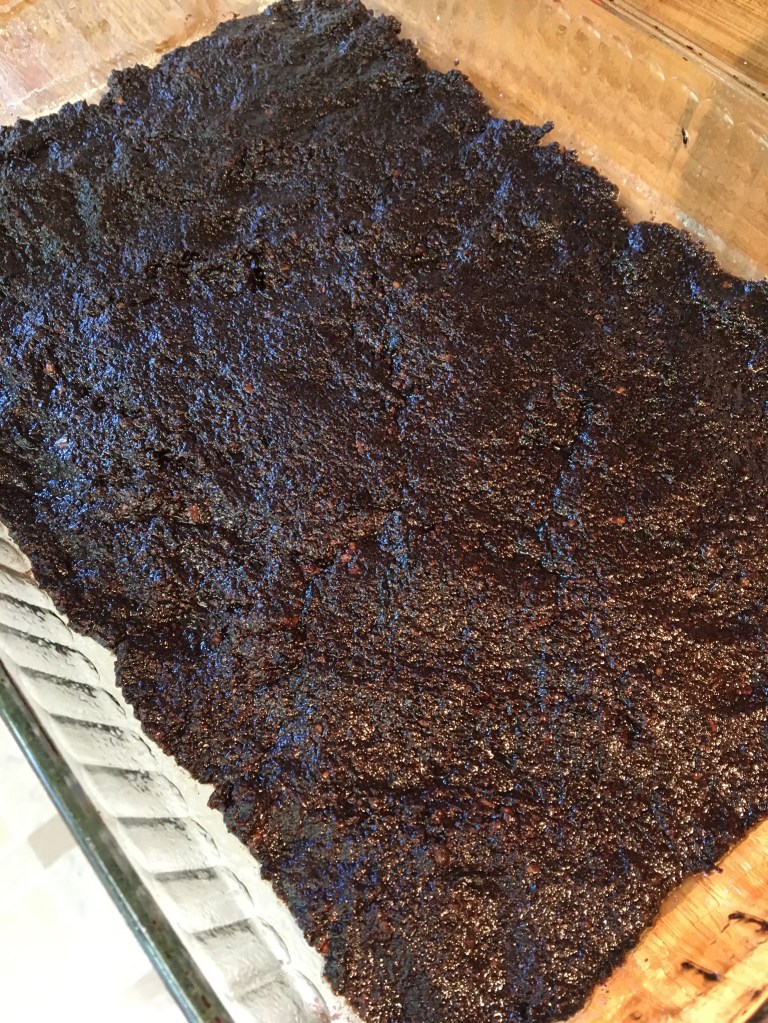
- First Layer
- 1 cup butter
- 1/2 cup baking cocoa
- 1 egg yolk, room temperature
- 2 cups graham cracker crumbs (I crushed one packet)
- 1/2 cup powdered sugar (confectioners’ sugar)
- 1 tsp. vanilla extract or paste
Prepare a 9×13″ pan by spraying with non-stick spray or greasing.
In a large saucepan over medium heat, melt butter and stir in baking cocoa. Stir over heat until mixture is smooth. Temper the egg yolk by whisking a little of the hot mixture into the egg yolk, continue whisking and add a bit more hot mixture. Then stir the egg yolk mix into the butter/cocoa in the saucepan. Continue stirring constantly over medium heat for 2-3 minutes until mixture thickens. Remove from heat and stir in graham cracker crumbs, powdered sugar, and vanilla. Stir until well mixed. Press into the prepared pan and refrigerate until the next layer is ready.
- Second Layer
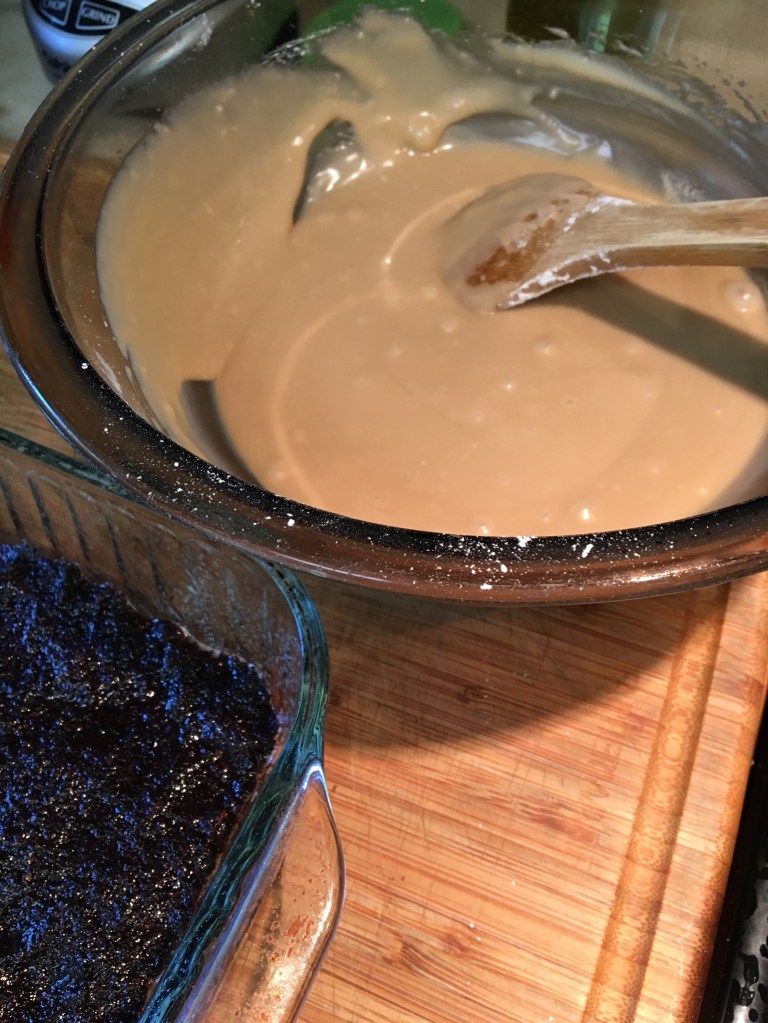
- 1/2 cup melted butter
- 1/3 cup Kahlua
- 3 cups powdered sugar
Stir Kahlua into melted butter until well mixed. Stir in powdered sugar. Spread over First Layer (it’s okay if it’s still warm). Refrigerate until set.

- Third Layer
- 1/4 cup butter, cubed
- 3 oz. semi-sweet chocolate chips
Melt together until smooth. Spread over top of the chilled and set Second Layer. Refrigerate until set.
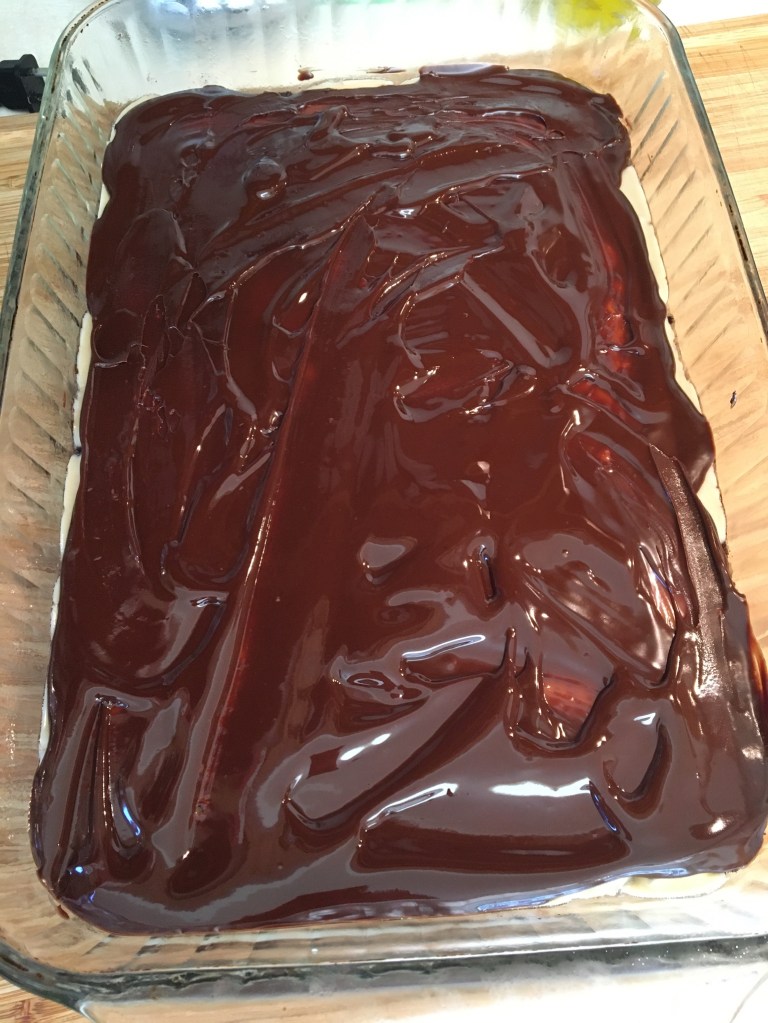
Cut into serving pieces and serve!
Store in refrigerator.
 Foods Passion